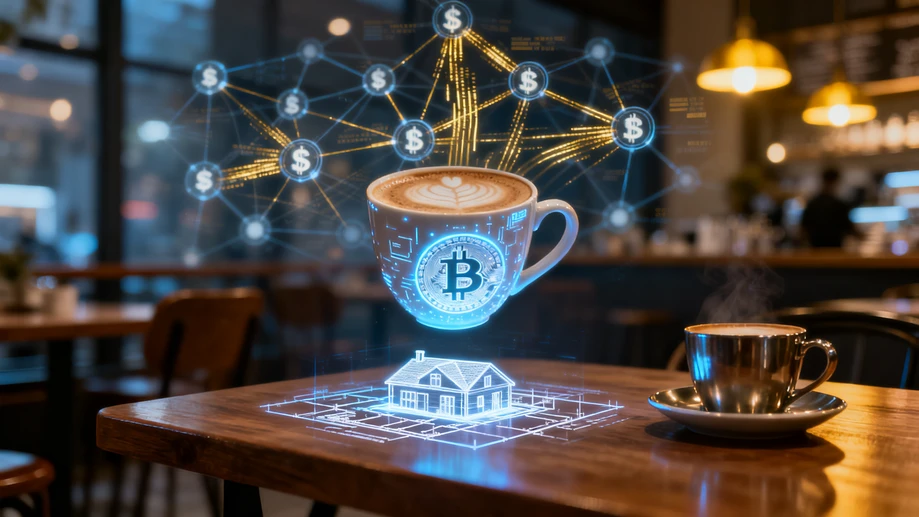
Is Your Coffee Buying You a House? Web3's Weird World of Ownership
Forget the Metaverse hype; discover how everyday digital actions are quietly rewriting the rules of who owns what online.
Remember that fancy latte you bought this morning? Or the hours you spent grinding in that online game last week? What if those everyday actions, those tiny digital breadcrumbs we leave constantly, weren't just gone? What if they actually built something tangible for *you*? That's the core promise of Web3, hidden beneath mountains of jargon and confusing NFT monkey pictures. It’s not about strapping on bulky VR goggles; it's a fundamental shift in power, putting ownership back into the hands of users for the very first time. The internet is getting a renovation, and this time, you might actually get a key to the building.
The difference lies in the architecture. Web2, the social media and app-dominated world we know, operates like a giant, glittering shopping mall. You visit the shops (platforms like Facebook, Instagram, Spotify, Uber), enjoy the services, maybe even create content (posts, playlists, reviews). But ultimately, the mall owner controls everything. They set the rules, take a hefty cut of every transaction, and can evict you or change the layout overnight. Your digital belongings and contributions? They reside on the mall owner's servers. Web3, driven by technologies like blockchain, aims to dismantle this mall. Imagine instead a bustling, open marketplace built on a shared, public ledger – a giant, unhackable digital notebook that everyone can see but no one person controls. This is the foundation: decentralization. It means your digital identity, assets, and data don't live on Mark's or Elon's servers; they live in a network secured by cryptography and maintained by thousands of computers globally. Ownership isn't just proclaimed; it's mathematically verifiable and portable.
This is where tokens come in. Think of them as digital keys or certificates. Tokens, living on the blockchain, can represent almost anything: a sliver of ownership in a song (like owning a piece of a musician's future royalties), exclusive access to a creator's community, a unique digital collectible (an NFT proving you own that specific image file), or even voting power within a digital project. Suddenly, that playlist you meticulously curated isn't just boosting Spotify's ad revenue; it could generate tokens representing your taste influence. That game sword you spent hours earning? It could be a verifiably unique NFT you truly own, potentially sellable in an open marketplace, not locked within the game company's walled garden. The musician you stream obsessively? You could hold tokens giving you early access to tickets or a say in their next release, funded directly by the community, bypassing traditional labels. This isn't science fiction; musicians like RAC and Kings of Leon have experimented with token-based albums and perks, while platforms like Audius offer decentralized music streaming.
Perhaps the most tangible early impact is in finance. Decentralized Finance (DeFi) protocols, built on blockchains like Ethereum, Solana, and Polygon, recreate traditional financial services – lending, borrowing, saving, trading – but without the banks, brokers, or paperwork. Anyone with an internet connection (and yes, serious caution) can potentially lend their crypto assets to earn interest, borrow against their digital holdings, or swap tokens peer-to-peer. While volatile and risky, it offers unprecedented access. Imagine a farmer in a remote region accessing a loan via a smartphone app secured by their digital assets, bypassing a local bank that might not even exist. Or consider micro-payments becoming frictionless: paying a fraction of a cent to read a single news article, or tipping a content creator directly with a single click, with the value flowing instantly to them minus exorbitant platform fees. Services like Uniswap (token swapping) and Aave (lending/borrowing) are already handling billions in transactions daily, proving the concept works, even if the user experience remains clunky for newcomers.
Of course, Web3 isn't a utopia. The technology is young, complex, and faces significant hurdles. Transaction speeds can be slow and fees high on popular networks ("gas fees" on Ethereum can sometimes cost more than the transaction itself!). The user experience – managing crypto wallets, remembering complex seed phrases, understanding smart contracts – is notoriously intimidating for average users. Security is paramount; losing your private key means losing access forever, with no customer service to call. Scams and hacks are unfortunately common in the wild west phase. Environmental concerns around the energy consumption of some blockchains (like Bitcoin's original proof-of-work model) sparked valid criticism, though many newer networks (like those using proof-of-stake) are vastly more efficient. Regulation is also playing catch-up, creating uncertainty. These aren't minor bugs; they're foundational challenges that need solving for mainstream adoption.
So, is Web3 going to instantly make your coffee habit a down payment? Probably not tomorrow. But the underlying shift is profound. It's about reimagining the digital economy where users aren't just the product, but active stakeholders and owners. It's about creators connecting directly with their audience and capturing more value. It's about communities having a real say in the platforms they use. The tools are still being forged, the risks are real, and the hype is deafening. Yet, beneath the noise, a quiet revolution is brewing. It's not about escaping to a virtual world; it's about fundamentally changing who benefits from the one we already inhabit. The next time you click, stream, or scroll, ask yourself: who really owns this interaction? Web3 offers a different answer, and it’s worth paying attention.